
Startup
Myriagon zet in op nieuwe behandeling voor neuropathische pijn | Start-up Spotlight Universiteit Leiden, Deel 2 van 3
Behind every successful biotech venture is not only groundbreaking science, but also people who know how to turn discovery into impact. As Head of New Ventures at VIB, Griet Vanpoucke sits at that intersection, bridging academic excellence with entrepreneurial execution. We asked Griet some questions about her career path and believe her advice offers valuable lessons for anyone considering a move beyond academia.
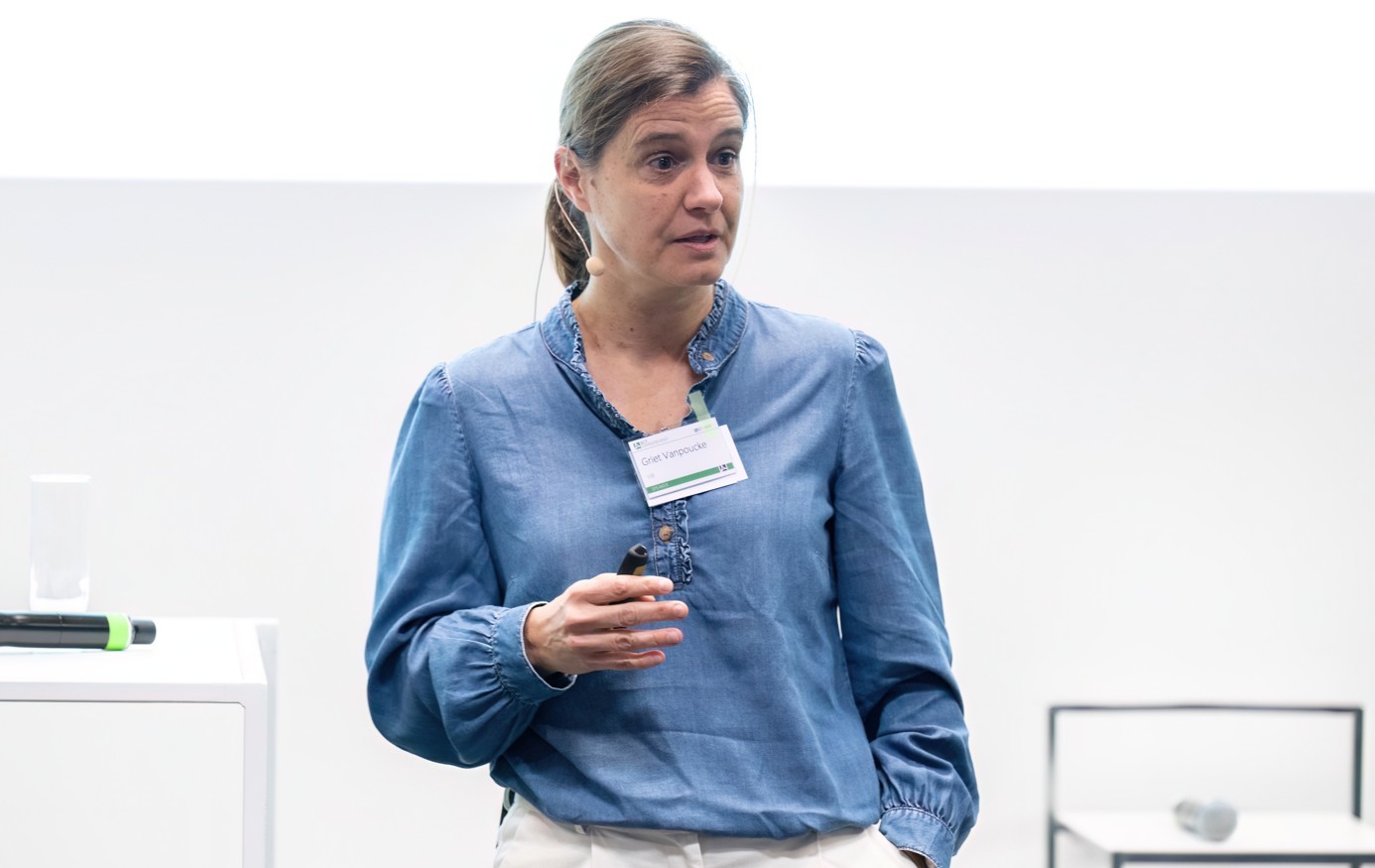
Griet Vanpoucke giving a keynote at BCF Career Event Belgium Photo by:
Before we dive into your work, could you tell us a bit about the person behind the role of Head of New Ventures at VIB? How do you like to unwind outside of work?
For me, unwinding is very simple: sports. I’m an avid cyclist and spend quite a bit of time on my race bike. If I don’t have enough time for a long ride, which usually means being away for a few hours, I go running for about half an hour instead. I’m also part of a female cycling club. During the holidays, we often go out together to climb mountains, almost like mini Tour de Frances. What I love about cycling is that when you’re riding uphill, the only thing you can think about is how on earth do I get up there. It’s the perfect way to fully disconnect from work.
Looking back at your career, could you briefly walk us through your path before joining VIB?
I started in academia with a PhD at Ghent University in a VIB lab. After that, I spent three years in the UK as a postdoc. We moved to the UK because of my partner’s career, where I worked with a great group leader from whom I learned a lot. After those three years, it became clear to me that academia wasn’t for me. When we moved back to Belgium, I started looking for a job without really knowing what I wanted—except that it wasn’t academia. That period was quite frustrating and disappointing. I was applying for jobs and getting nowhere, until someone gave me very good advice: stop just writing letters and start talking to people at conferences and events.
That’s how I learned that a VIB startup called Peakadilly (later Pronota) was closing a financing round and hiring. I applied, even though I had never seen a mass spectrometer up close. During my first interview, I had to complete an exam and didn’t know half the answers, but they let me present my own work. There was a click with the management team and I was hired. I joined as a scientist in 2006 and quickly moved up in the organization. That’s the nice thing about startups: if the team is small, there’s a lot to do, and opportunities come quickly. I stayed until the company was acquired in 2014.
When the acquisition became clear, I started looking around again. I got in touch with Johan Cardoen, former managing director of VIB, who at the time was also chairman of the board at Pronota. At a reception, I met Els Beirnaert, at that time responsible for new venture creation at VIB. We started talking, and again there was a click. I thought: how amazing is this—you get to work with top scientists and brainstorm how to build ventures around their science? That’s how I ended up at VIB, where I’ve been for 11 years now. Even though I am still doing the same job, I am really enjoying it because we have a fantastic team and environment. One day I’m working on a therapeutic project, the next day on something related to an area I knew nothing about before. You’re constantly exposed to new science, new ideas, and new challenges. It never gets boring.
How does the New Ventures team at VIB operate, and how is it different from a traditional tech transfer office?
We’re a small team, five people, but we’re embedded in a much larger innovation and business unit of around 50 colleagues. We work in a matrix organization, meaning that for every project, we collaborate closely with IP experts, business developers, colleagues from our drug discovery unit and the scientists at VIB.
We’re very opportunistic. As a non-profit research institute, VIB can take on very early-stage, high-risk projects that are still too risky for investors or companies.
For novel inventions, whether that’s a breakthrough therapeutic or a novel technology, we generate enough proof-of-concept and value so that they can eventually become viable ventures. Our ambition is always to create the next successful biotech company.
But because this is extremely early-stage work, many projects fail. That’s why we manage a broad portfolio, around 50 projects in total. The work is a lot about collaborating with people, scientists, colleagues, future investors. We see ourselves as the glue that holds everything together. We make sure science advances, patents are filed at the right time, entrepreneurs are brought in when needed and business plans are developed and pitched to investors. It takes patience. On average, we work three to five years on a project before it becomes a well-financed new venture.
You mentioned patience. How does the current financing climate affect your work?
Things are definitely taking longer. Investors are moving toward later-stage opportunities, which means we need to de-risk projects even more internally. At VIB, that’s okay as we have time and we’re not under the same financial pressure as startups. We don’t spin out companies just for the sake of it. We only do so when there is sufficient financing and when we’re genuinely convinced the company can succeed. We’ve never created a company knowing from the start that it wouldn’t make it. We first convince ourselves before going to external parties.
How is venture financing typically handled at VIB?
V-Bio Ventures is a very important partner. VIB founded it ten years ago as an early-stage venture fund, but it operates independently. They have preferential access to our deal flow, but there’s no exclusivity, about half of our ventures include V-Bio Ventures. Fundraising is really about networks. Besides local partners like PMV and the university funds, we work extensively with blue chip European and US investors. One of our goals is to attract more international capital into the region.
How do you de-risk projects internally before seeking external funding?
A major step was launching our internal drug discovery unit in 2018. It’s staffed entirely by industry-trained professionals with experience in biologics, small molecules, and antisense technologies. This allows us to pair excellent academic science with real drug development expertise at a stage when money doesn’t yet dictate decisions. Many people joined this unit because they can work on projects that were simply too risky to pursue in industry.
That said, we don’t just take on any project. Every project goes through a thorough analysis: scientific relevance, medical and commercial need, IP. Anyone in our organization can propose a project, but they must convince their peers. If they do, we move forward.
What advice would you give to PhDs and postdocs who are interested in a career in business development or venture creation?
First, manage your expectations. Don’t expect to immediately land your dream business role straight out of academia. A very good first step is to work in industry, even as a scientist.
That will give you invaluable insight into how companies function. Once you understand industry from the inside, you can grow into other roles, including business development. Scientists in industry are incredibly valuable because they understand how drug development or technology development really works.
Second, talk to people and network. And in addition to scientific literature, staying up to date with industry newsletters is a great way to understand what’s happening across the biotech ecosystem. Awareness of the ecosystem is crucial.
Any final thoughts or advice?
If you have the opportunity, work in a different country or environment. That experience is incredibly rewarding. You learn how to navigate different cultures and systems, and that teaches you more than changing jobs within the same country ever could. Today, mobility is more common than it used to be, but its value goes far beyond academia. It’s just as useful for careers in industry, business, and venture creation.