Opinion
What will women do when AI takes over our jobs?
4 min read
When people talk about “inequality” in women’s health, the conversation often stops at representation: not enough women in research, on boards, or in funding rooms.
But the deeper truth is more structural.
Even if tomorrow every investor and researcher were gender-balanced, the pipeline that turns ideas into diagnostics for women would still be broken. What we face isn’t simply gender inequity. It’s a market failure. One that can be measured, quantified, and, crucially, redesigned.
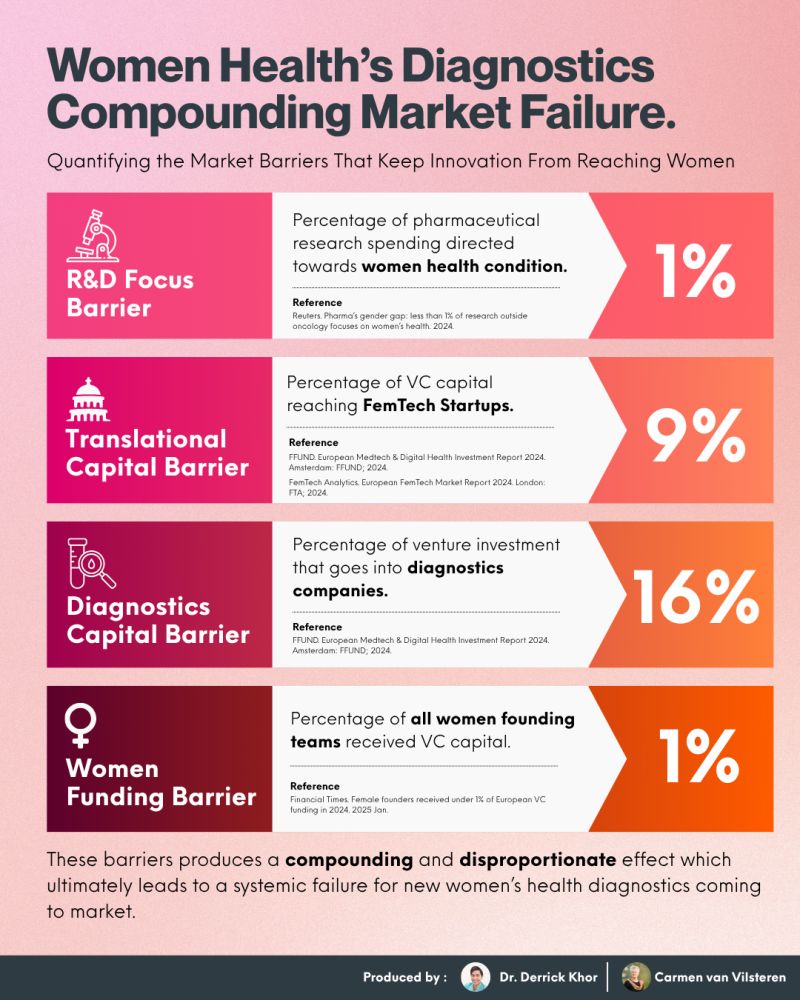
1. The R&D Focus Barrier: Only 1% of Pharmaceutical Research Targets Women’s Health
Let’s start at the source.
Across Europe, less than 1% of pharmaceutical R&D spending outside oncology is directed toward women’s health conditions. [1]
This means 99% of early-stage scientific discovery bypasses the unique biological and clinical needs of women altogether.
EU frameworks such as Horizon Europe have funded more than €2 billion across over a thousand women’s-health projects, but this still represents a fraction of overall EU health R&D.
In other words: the scientific seedbed itself is thin. [2]
When 99 out of every 100 research euros never touch women’s health, the downstream scarcity of validated diagnostics isn’t surprising - it’s inevitable.
2. The Translational Capital Barrier: Only 9–12% of Health VC in Europe Reaches FemTech
Even when research exists, it rarely translates into products.
In 2024, European FemTech companies raised between €339 million and €437 million, accounting for roughly 9–12% of all medtech and digital-health investment across the continent.[3,4]
That may sound promising - until you realise it includes the entire spectrum: fertility tracking, pregnancy, menopause, endometriosis, mental health, and diagnostics.
Within that slice, diagnostic tools remain a small minority, often considered “too niche,” “too slow,” or “too uncertain” for mainstream venture returns.
The result? promising biomarkers and AI-based diagnostic models for conditions like endometriosis or PCOS rarely advance beyond pilot studies.
3. The Diagnostics Capital Barrier: Only 16% of EU Medtech Deals Involve Diagnostics Companies
Diagnostics themselves — regardless of gender focus — have long struggled to attract capital.
In 2024, only 47 of 291 European medtech and digital-health deals involved diagnostic companies, representing about 16% of deal volume. [4]
While therapeutics promise billion-euro exits, diagnostics are typically seen as slow-burn investments requiring regulatory validation, clinical partnerships, and reimbursement alignment - all of which are high friction in fragmented European markets.
For women’s-health diagnostics, this compounds with the upstream scarcity of gender-specific research.
You can’t commercialize what hasn’t been studied, and you can’t validate what isn’t funded.
4. The Women-Founder Funding Barrier: Less Than 1% of EU VC Capital Goes to All-Female Teams
Finally, even when a viable diagnostic idea exists, the leadership shaping it faces its own barrier.
Across the European Union, all-female founding teams received less than 1% of total venture capital in 2024, while mixed-gender teams received about 27.8%. [5]
This founder gate matters because the majority of FemTech and women’s-health diagnostic startups are led (or co-led) by women.
If women founders systematically raise less capital, women’s-health diagnostics will remain underdeveloped by design.
5. Why This Matters
These aren’t abstract numbers.
They explain why the average time to diagnose endometriosis remains 8–9 years in the UK and Europe; [6] why non-invasive diagnostic tests for female-specific conditions remain largely unvalidated;[7] and why clinical guidelines rely on symptom exclusion rather than precision diagnostics.
In economic terms, this is a failure of allocation efficiency: capital, data, and talent are misdirected away from half the population.
6. The Women’s Health Investment Opportunity
Closing the women’s health gap could add at least $1 trillion to global GDP annually by 2040 [8], driven by reduced morbidity, higher labor participation, and more healthy days lived per woman. For investors, that is a secular tailwind—bigger than a category; it is an economy-wide efficiency gain that rewards solutions which shorten diagnostic timelines and expand access.
Shortening time-to-diagnosis for conditions like endometriosis or accelerating HPV screening doesn’t only reduce suffering - it recaptures workforce participation and productivity at national scale. Endometriosis-related sick leave alone is estimated at ≈ €30 billion per year [9]
The World Economic Forum/McKinsey analyses project ~$3 in economic growth for every $1 invested in women’s health (a 3:1 macroeconomic return). [8]
The women’s-health gap is not just a moral issue, it’s an economic inefficiency waiting to be corrected.
7. The Path Forward
Fixing this isn’t about charity or quotas, it’s about correcting a mispriced market.
Europe can act decisively by:
Expanding targeted R&D tax credits for women’s-health conditions.
Creating translational grant bridges between Horizon research outputs and clinical validation programs.
Incentivising diagnostics-specific funds with longer time horizons.
Requiring gender equity reporting for venture portfolios.
Because until women’s health is treated as a growth market and not a “special interest”, these numbers won’t move.
This analysis was created by Dr Zhong Wei Khor of Medical Consulting Group in collaboration with Carmen van Vilsteren, an exited healthtech founder with deep involvement in multiple women’s health companies who’s lived this reality from both sides, building companies and navigating the barriers first-hand.