Opinion
How to build a patent portfolio around a new therapeutic product
4 min read
The chances for a successful development of a new therapeutic product have proven to be dependent on a strong patent portfolio. When building a patent portfolio around a newly developed pharmaceutical compound platform many opportunities occur to steadily extend the patent protection, using and applying the growing insights during the early stage, pre-clinical and clinical development stages of the new therapeutic.
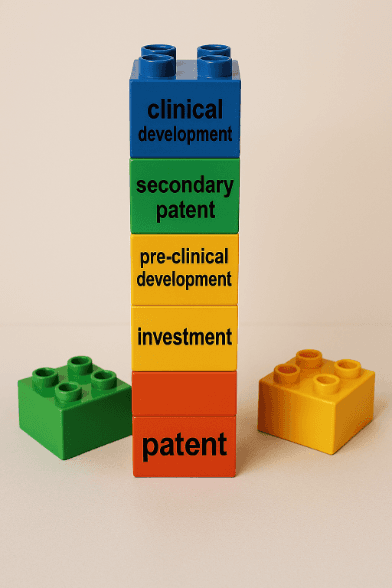
In early stage of development, new active compounds, such as small molecule compounds or other therapeutic modalities, are identified. Such development is commonly based on a known pharmaceutical target, which is related to a medical indication.
Once the principal activity of the new compounds has been found in (in vitro) models related to the target, a first patent application (called basic patent) can be filed at the relevant patent authority for the new compounds.
A filing of the first patent application can be used to early protect the development of the new pharmaceutical compound platform. For instance, such an early filing may be desirable to reach out to possible investors to pursue investments.
The patent application beneficially contains claims to provide a broad coverage of the chemical structures of the new active ingredients. Commonly for small molecules a Markush formula approach is used to broaden the coverage including relevant variations of substituents of the chemical structures.
After filing the first basic patent application many options remain for getting additional protection for further aspects of the pharmaceutical compound and its application, for example the medical use, the pharmaceutical formulation, the dosage regime and/ or the administration form of the compound.
Thinking ahead of all possible building blocks in protection is key to the development of a strong patent portfolio for the new medical compound.
An example of successful protection by a patent portfolio is Keytruda, which is approved across multiple indications. The basic compound patent expiration year is 2028, while the patent portfolio for Keytruda, which is built over time by many patent applications, gives extensive protection for new indications, formulations, and combination therapies.
However, when not proactively thinking ahead of options along the road for building the patent portfolio and the timings of addressing these options, we see the occurrence of pitfalls in first or other early patent applications which, once overlooked, often cannot be remedied later.
For example, in early stage it is common practice to identify as many medical applications of the new pharmaceutical compound as possible, which could be targeted by the new pharmaceutical compounds. Such a long list of medical indications is then used to select a first focus area of application of the new pharmaceutical compounds and to select suitable models to assess the feasibility for addressing said focus application area.
Concurrently, we see often a tendency to mention all or at least many of these possible medical indications in a first patent application. For example, the target may be very relevant and tested for one or more cancer indications on relevant models, and at the same time no data is available which provide evidence for the use of the same compounds for other medical indications.
However, mentioning a medical indication in a patent application does not guarantee that a protection can be claimed for this medical indication based on this (e.g. first) patent application. Patent law and patent authorities apply stringent requirements to medical use claims (which cover the medical indication), which restrict the possibility for obtaining protection for such medical use claims. For example, in case no model data, which relate to the specific medical indication, is enclosed in the patent application, it is not upfront certain that a patent authority will grant protection. Besides, the requirements in such a situation also differ among the various jurisdictions or patent authorities.
At the same time, mentioning a possible medical indication in general in the first application may also restrict or hinder to obtain protection later, based on another later (secondary) patent application, which claims the same medical indication. Even if the later secondary patent application does contain relevant data as evidence based on the pharmaceutical compounds, while the first application does not contain the data.
Thus, when building a patent portfolio, and starting from a first patent application, it makes sense to think ahead of further options for protection along the road of pre-clinical development and clinical development and make thoughtful decisions what to include at what time and what not to include in the first patent application and each of the following patent applications.
Even more, the relevancy of a strong patent portfolio for a successful development and introduction of a new therapeutic product can be illustrated by the following quote of a CEO of a successful innovator:
“Our patent portfolio is our lifeline or the reason of our existence.”
For any questions for building your patent portfolio, please contact us at:
Kolja Adamczyk; European patent attorney, pharma & life sciences, at NLO
NLO – B.V. Nederlandsch Octrooibureau
Email: Adamczyk@nlo.eu
Telephone: + 31 682789121